
DeKalb County Court Records After Arrest
A DeKalb County jail arrest does not automatically tell the whole court story. Booking occurs at the jail when a person is brought in on charges. Bond call may follow if the person cannot make bond or no bond has been set. The DeKalb County State's Attorney then decides what Illinois criminal-law or traffic charges to file or pursue. Once filed, the Circuit Clerk record becomes the formal source for the case number, filed charges, docket events, future dates, disposition, and sentencing.
Use jail inmate records for the custody side and jail roster mugshots for booking-photo questions. Use court records after a jail arrest to track what happened in court after booking. Arrest allegations, booking labels, and filed charges can differ because prosecutors may amend, reduce, add, dismiss, or decline charges as the case develops.
Find Court Records After DeKalb County Arrest
The local court-record custodian is the DeKalb County Circuit Clerk. The online records page covers traffic violations, DUI, criminal misdemeanors, criminal felonies, ordinance violations, and conservation tickets. The page says the search form may take a minute to load and that mobile devices are best viewed in landscape mode. Criminal, DUI, traffic, misdemeanor, felony, ordinance, and conservation matters route to 815-895-7138.
- Open the Circuit Clerk online records page and wait for the embedded search form to load.
- Use a desktop screen or landscape mobile orientation if the embedded app is hard to view.
- Search by the available court-app fields, or call 815-895-7138 if the page does not load or a record cannot be found.
- Review the case number, charge list, docket events, next date, and disposition rather than relying on the original arrest label alone.
- If no court case appears, call the jail for current custody and use the Sheriff's FOIA form for arrest or booking records.
| Portal | Visible notices | Notes |
|---|---|---|
| DeKalb County Circuit Clerk online records | Search form may take a minute to load; mobile is best in landscape mode. | Static source did not expose rendered search fields. |
| Embedded Profound UI court app | JavaScript app shell | Field labels were not confirmed from static inspection. |
Charges Filed After Jail Arrest
The arrest-to-court path moves from jail intake to charging. A complaint, information, or indictment starts or shapes the formal court record. The State's Attorney's Office is the prosecutor for Illinois criminal-law and traffic violations in DeKalb County and has staff in four courtrooms daily. Law-enforcement availability to that office is described as 24/7, which explains why charging decisions can move while custody and bond questions are still active.
| Document | What it is | How to read it |
|---|---|---|
| Complaint | A charging document often used to begin a criminal case. | Check whether the charge later changes or is replaced. |
| Information | A prosecutor-filed charging document for many felony or misdemeanor prosecutions. | Read it as the State's filed position at that point. |
| Indictment | A grand-jury charging document. | Do not treat it as a conviction. |
Charge Status in DeKalb County Court Records
Charge status changes as a case moves. A pending charge has not been resolved. An amended charge has changed from the earlier filing. A reduced charge is lower than a prior version. A dismissed charge is not being pursued in that case. A disposition is the final outcome. A conviction is a judgment or finding of guilt, not the same thing as an arrest.
| Status | Meaning |
|---|---|
| Pending | The charge or case remains unresolved. |
| Amended | The filed charge was changed after the original filing. |
| Reduced | The charge was lowered to a lesser offense. |
| Dismissed | The charge was terminated without a conviction in that case. |
| Disposition | The final outcome, such as conviction, dismissal, plea, or sentence. |
Bond Call After DeKalb County Arrest
If an inmate cannot make bond or no bond is set, DeKalb County uses bond call by closed-circuit television. The public attends at the DeKalb County Courthouse, 133 W. State St., Room 220. Bond call is Monday through Friday at 1:00 p.m. and Saturday at 11:00 a.m. After bond call, bond can be posted at the jail.
The sheriff's bond page says bond can be posted 24 hours a day, seven days a week at DeKalb County Jail. Accepted methods include cash, cashier or bank check payable to the DeKalb County Circuit Clerk, and MasterCard, Visa, or Discover credit card with matching valid photo ID. The credit card company adds an 8 percent fee. The sheriff also lists a $30 processing fee and a $75 Failure to Appear warrant fee when applicable.
| Item | Local detail |
|---|---|
| Bond posting | 24/7 at the jail |
| Bond call | Closed-circuit television, public attendance in Courthouse Room 220 |
| Credit card fee | 8 percent, charged by the credit card company |
| Processing fee | $30, separate from bond |
| FTA warrant fee | $75 in addition to bond when it applies |
Warrants Before DeKalb County Arrest
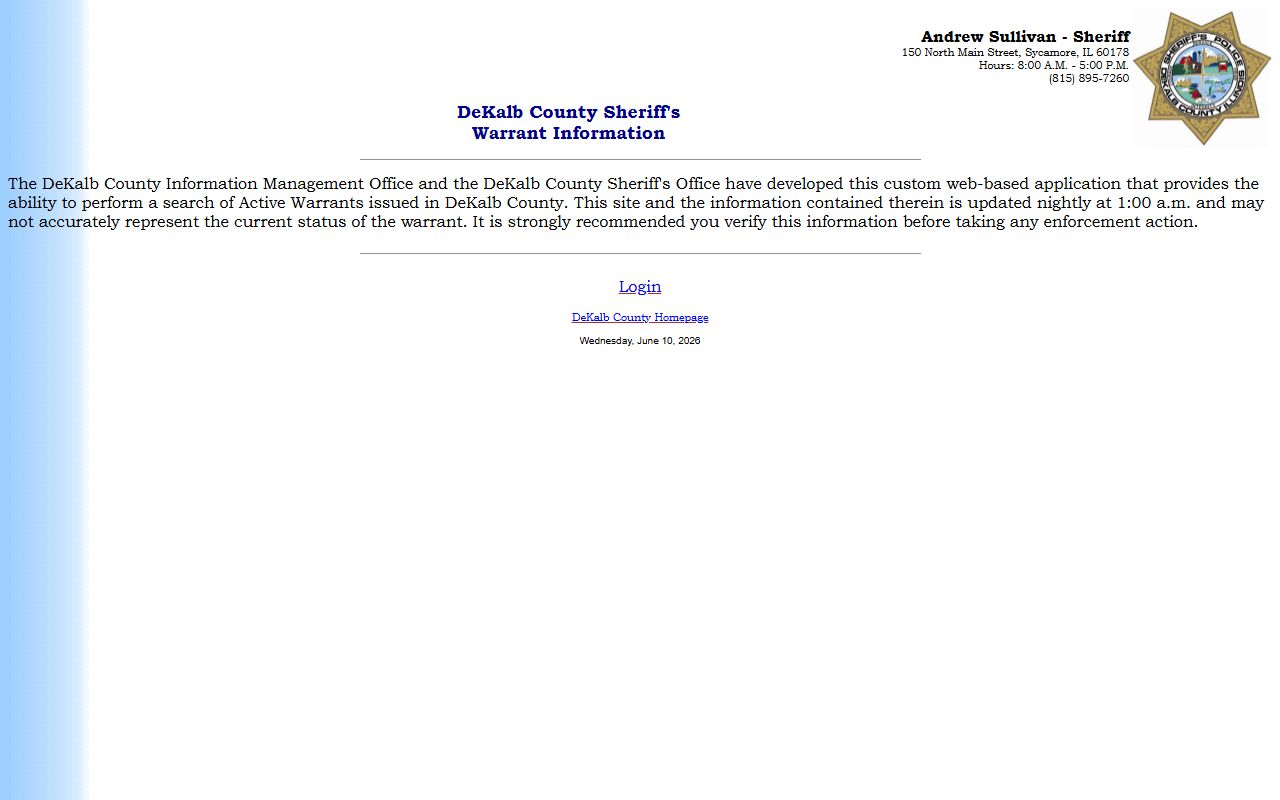
The county online-records hub links warrants, but the public description says the warrant search is for local agencies and authorized users only. The official DeKalb County Sheriff Warrant Information landing page exposes a login link, and the login page shows username and password fields. No anonymous public warrant name search was visible in the inspected official source.
The official warrant landing page says active-warrant information is updated nightly at 1:00 a.m. and should be verified before enforcement action.
People with failure-to-appear warrants or court-ordered sentencing surrender instructions may be directed to the jail lobby. The sheriff's warrant PDF says to bring photo ID and court documents and to avoid personal belongings other than photo ID, cash for bond, and court documents.
Charges vs Convictions
An arrest or charge is not a conviction. A charge is an accusation filed or pursued in court. A conviction requires a plea, verdict, or judgment of guilt. Court records after a jail arrest should be read with that distinction in mind, especially when a case is pending, amended, reduced, or dismissed.
| Charge | Conviction | |
|---|---|---|
| Stage | Accusation or filed count | Final guilt finding or plea outcome |
| Can change? | Yes, it can be amended, reduced, or dismissed. | Changes usually require further court action. |
| Search source | Circuit Clerk case record | Circuit Clerk disposition and sentence record |
Sealed and Expunged Arrest Records
Illinois law treats sealing and expungement differently. Sealing restricts public access to eligible records. Expungement is a stronger court process that can remove, impound, or destroy eligible records under Illinois law. The DeKalb County Circuit Clerk has an expungement filing page, and Illinois law at 20 ILCS 2630/5.2 governs eligibility and process.
| Sealed | Expunged | |
|---|---|---|
| Public access | Restricted from ordinary public view. | Treated as removed or destroyed where the order applies. |
| Government access | Some agencies may retain limited access. | Access is more limited and order-specific. |
| Use case | Eligible records that cannot or need not be expunged. | Eligible dismissals, acquittals, or other qualifying outcomes. |
Restricted Court Records After Arrest
Not every record is public online. Juvenile records, sealed records, expunged records, protected personal information, and some law-enforcement information can be restricted. Illinois FOIA section 5 ILCS 140/7 allows exemptions for certain law-enforcement records when disclosure would interfere with proceedings, endanger people, reveal confidential sources or methods, or fit another listed exemption. Court access rules also do not make every electronic file available from home.
If the online court record is missing or thin, the clerk's office remains the source for the official court file during regular office access. The Illinois remote-access policy does not turn every courthouse record into an online record.
Important: Online records can lag behind jail events; verify urgent custody and court-date questions with the jail or clerk.